Eberwhite Woods
Eberwhite Woods has stood behind the school since long before the building did. It carries the story of Mr. Eber White himself, a University of Michigan laboratory, and eight decades of Ann Arbor Public Schools ownership.
Parents, Students, Neighbors, and the Eberwhite Woods PTO are working to keep this unique AAPS forest standing - through stewardship, education, and a closer look at what's actually growing here.
Join the Email List (opens in a new tab)Downloadable Activities
Stay up to date
Join the email list to stay up to date on all upcoming stewardship work days.
Join the Email List (opens in a new tab) Ask the Eberwhite Woods PTO CommitteeElementary School Age Activity
A printable activity for elementary school aged kids. Placeholder - the activity sheet is coming soon.
Download the Elementary Activity (PDF) (PDF, opens in a new tab) Additional resource (link coming soon)All Ages Activity
A printable activity for the whole family, from the youngest explorers to grown-ups. Placeholder - the activity sheet is coming soon.
Download the All Ages Activity (PDF) (PDF, opens in a new tab) Additional resource (link coming soon)Eberwhite Woods Visit Guide
What are the posted rules and safety notices?
Natural area for student study. Trees and limbs may fall at any time, especially during high winds. Fallen trees and limbs provide habitat and replenish the soil.
Please stay on the trails so the natural features will be preserved for the education and enjoyment of all visitors. No unauthorized cutting or removal of plant material is permitted.
Under city ordinances: 9:47(1), dogs must be leashed and in your hand. 9:47(5), dog feces must be taken out of the woods. No smoking, by city ordinance (Ord. No. 14-03). Stay on paths. No motorized vehicles. Do not collect wildlife or wildflowers. No camping or fires. Do not litter or dump.
How can I get involved with stewardship?
Join the email list (opens in a new tab) to stay up to date on all upcoming stewardship work days.
Is Eberwhite Woods open to the public?
Yes. Please keep in mind that Eberwhite Woods is Ann Arbor Public Schools property. You may see students learning in the woods.
Does the city of Ann Arbor manage the Eberwhite Woods?
No. Eberwhite Woods is owned by Ann Arbor Public Schools and maintained by students, families, and neighborhood volunteers. The City of Ann Arbor owns and manages the adjacent 2.5-acre Eberwhite Nature Area (near Zion Church) and Fritz Park between Eberwhite Elementary and Pauline Boulevard. The larger, 30-acre Eberwhite Woods has been owned and managed by Ann Arbor Public Schools since 1946. See the history document for more information.
Who maintains the trails?
Eberwhite Elementary staff and students, the PTO Woods Committee, families, and neighborhood volunteers help care for the trails. Their work includes spreading wood chips, clearing fallen branches, and managing invasive plants. Ann Arbor Public Schools owns and manages the woods.
What are the mysterious orange metal signs?
The markers are from an old Eberwhite Woods nature trail! In May 1961, 50 heavy steel markers were installed along a three-quarter-mile self-guiding trail, designed for the use and enjoyment of visitors by Prof. Grant Sharpe and students of forest recreation from the University of Michigan’s School of Natural Resources. The work was done by Explorer Scout Post 105 under Byron H. Amrine’s leadership. The trail affords an excellent opportunity to observe some of the natural history of the area.
Most of the highlighted features no longer exist, but the Woods Committee has plans to make an updated self-guided tour.
Where are the entrances to the woods?
There are several entrances: paths by Eberwhite Elementary, an entrance on Ivywood Drive, an Arbordale Street pathway, stairs from Liberty Street, and connections through the adjoining Eberwhite Nature Area and Fritz Park. See the trail map for the paths and landmarks.
How many acres are the woods?
The school district's Eberwhite Woods covers about 30 acres. The adjacent 2.5-acre Eberwhite Nature Area belongs to the City of Ann Arbor and is a separate property.
Where does water from the woods go?
The open stream channels in Eberwhite Woods are part of the Eberwhite branch of Allen Creek. From the woods, this branch travels east through Ann Arbor's drainage system, crossing Seventh Street and joining the main creek near William Street, then flows into the Huron River. Trees, plants, and soil in the woods absorb and slow runoff, helping protect the creek and river during storms.
Who do I contact with questions?
Trail Map
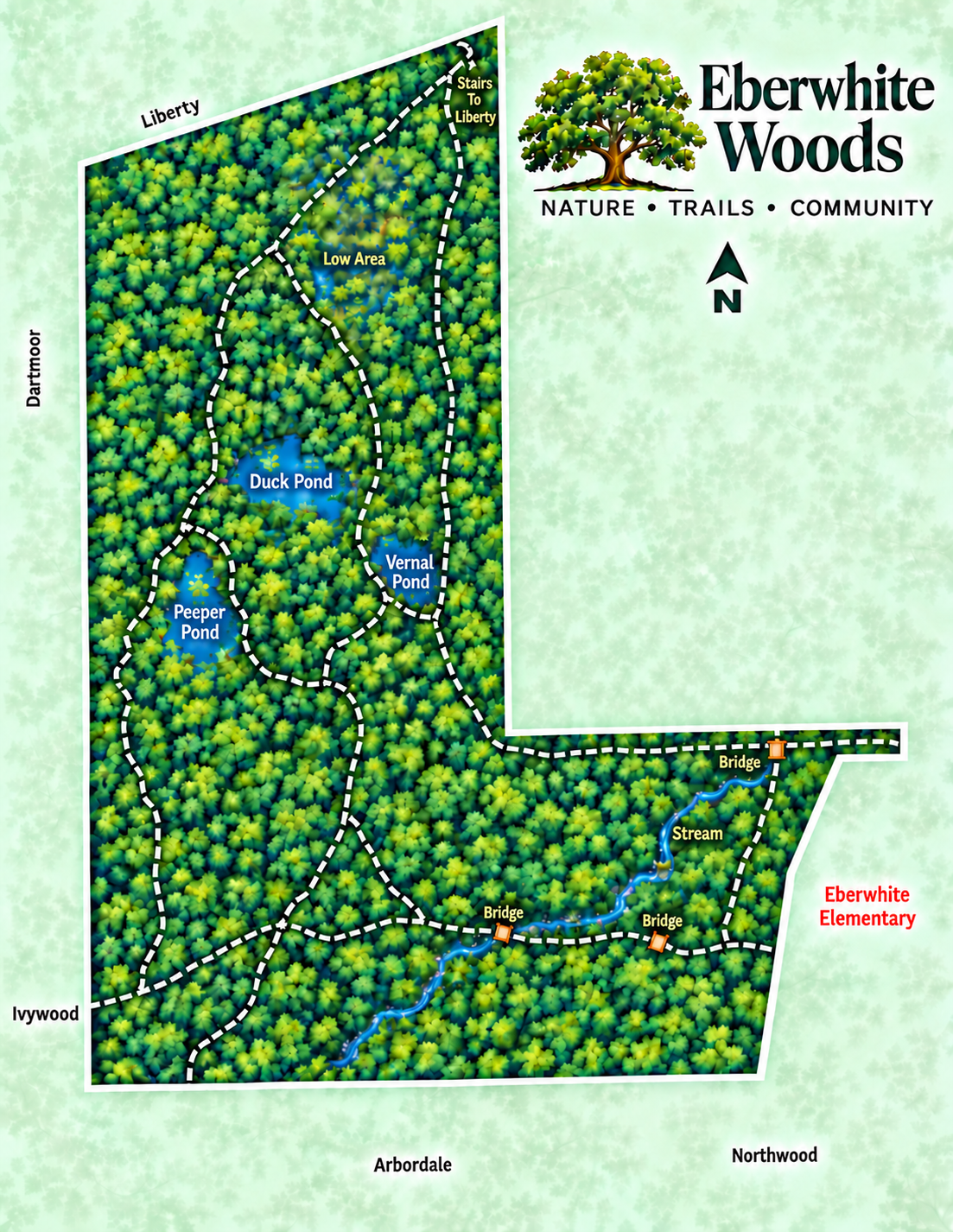
Trails wind through Eberwhite Woods from north to south, passing three ponds in the north-central and western portions of the property.
Trail entrances and access
The perimeter loop is suitable for hiking and walking, with additional trails connecting different parts of the main loop. Generally described as easy, the perimeter loop takes approximately 30 minutes to complete, depending on your pace and trail conditions. Dogs are welcome but must remain on a leash.
Entrances include paths by Eberwhite Elementary, an entrance on Ivywood Drive, an Arbordale St pathway, stairs from Liberty Street, and connections through the adjoining Eberwhite Nature Area.
Plants of Eberwhite Woods
A Brief History of the Eberwhite Woods
Before 1824
Indigenous Stewardship
Ojibwe, Ottawa, Potawatomi, and Wyandot people lived in and traveled through this land, which the City of Ann Arbor formally acknowledges as part of the traditional territories of the Anishinaabe, Three Fires Confederacy, and the Wyandot. Indigenous stewardship of the land helped shape the oak-hickory forest still standing today.
1824
Mr. Eber White Arrives
Just three months after Ann Arbor's founding, White buys roughly 160 acres along what's now Liberty Road - once called St. Joseph's trail by the indigenous stewards, before being informally called "White's Road" - and keeps its hilly, swampy back portion untouched, as the land we now call Eberwhite Woods.
1830s-1865
Underground Railroad Stop
White's home, near the southeast corner of West Liberty and Eberwhite Boulevard, becomes a documented stop on the Underground Railroad, helping freedom seekers reach Canada.
1872
Mr. Eber White Dies
White dies in August 1872, aged 74; his land later passes through his estate toward subdivision.
1915
University of Michigan Steps In
As Mr. Eber White's former land is subdivided for homes, U-M purchases the wooded portion for its Forestry Department, one of several U-M outdoor research sites alongside Saginaw Forest.
1927
A Teaching Forest: The School of Forestry and Conservation
In 1927, the University of Michigan elevated its forestry program to a full School of Forestry and Conservation - one of only a handful of dedicated forestry schools in the country at the time. For Eberwhite Woods, the school's founding formalized and deepened the work that began in 1915. The woods' closeness to campus made them ideal for the repeated, hands-on field work the school required. Students did not simply visit; they inventoried, assessed, and managed the forest.
By 1942
Selectively Logged
Eberwhite Woods had been selectively cut over at least twice under University management, but has never been clear-cut. Ironwood was the most common tree removed. Circular metal tree survey markers from this era can still be found today.
1945
A Fight to Save Eberwhite Woods
After the City Council stalls on an earlier U-M offer, an Ann Arbor News editorial celebrates the pending transfer to Ann Arbor Public Schools, comparing it to Grand Rapids' John Ball Park.
1946
Gifted to AAPS - With a Catch
U-M deeds the land to Ann Arbor Public Schools, conditioned on its use for school, educational, or recreational purposes. If AAPS ever stops using it that way, the University has a 90-day right to reclaim the land - a reversionary clause that has protected the woods for nearly eighty years.
1950-1951
Eberwhite Elementary Opens
Construction begins in 1950 on the southeast corner of the gifted land by clearing timber to make room for the school. Eberwhte Elementary school opens to students on January 29, 1951.
1959-1961
The Woods Become a Classroom
William Stapp is hired in 1959 to build a formal outdoor education program for every grade level. When the program launches in 1961, students are told: "This is your woods. It belongs to all the people of Ann Arbor. A school takes but a year or so to build. A woods like this will take hundreds of years to grow."
May 1961
A Self-Guiding Nature Trail
Explorer Scout Post 105, led by Byron H. Amrine, installs 50 heavy steel markers along a three-quarter-mile trail designed by Prof. Grant Sharpe of U-M’s School of Natural Resources.
1961
The Woods Nearly Change Hands
A dispute over a $21,599 storm sewer assessment nearly leads AAPS to trade Eberwhite Woods to the City of Ann Arbor in exchange for canceling the bill. The deal requires the University's sign-off under the 1946 deed; although agreements were made, the transfer never finalizes, and the woods stay with Ann Arbor Public Schools for recreation and education.
1963
Designated a Nature Study Area
On October 6, the Michigan Natural Areas Council formally dedicates Eberwhite Woods as a Nature Study Area - the first such designation for a school-owned property anywhere in the country.
1965
A Fungus Found Nowhere Else
The species Boletus eberwhitei is collected in Eberwhite Woods - and has not been documented anywhere else on.
April 1985
Woodchip Day
Every year, every classroom joins in to spread fresh wood chips along the trails. Woodchip Day, already underway by April 1985, is the most important stewardship tradition of the woods - a celebration of students caring for the place where they learn, handed down from one class to the next for generations.
2007
The Nature Area Expands
The City of Ann Arbor buys 2.5 adjoining acres from Zion Lutheran Church, creating a continuous forested corridor. Ann Arbor Public Schools retains ownership of the larger Eberwhite Woods.
Today
Community Stewardship Continues
The Eberwhite Woods Committee, restarted in 2026 focusing on connecting kids to nature: cultivating curiosity in and respect for the Eberwhite Woods. The committee continues traditions that include the wildflower walks, the annual Woodchip Day trail maintenance event (documented since spring 1985), and learning about their amazing classroom in the woods.
Volunteers and students keep the promise made in 1946 alive, one work day at a time.
Report a Trail Issue
Let the committee know
Fallen tree, or unsafe spot on the trail? Let the committee know. Selecting the button below opens a short form that goes to the Eberwhite Woods PTO Committee.
Open the Report Form (opens in a new tab)GOOD THINGS TO INCLUDE
- What you saw (downed tree, trash, erosion, vandalism)
- Roughly where in Eberwhite Woods - nearest trail landmark
- A photo, if the form lets you attach one
- Whether it looks urgent or can wait for the next work day